
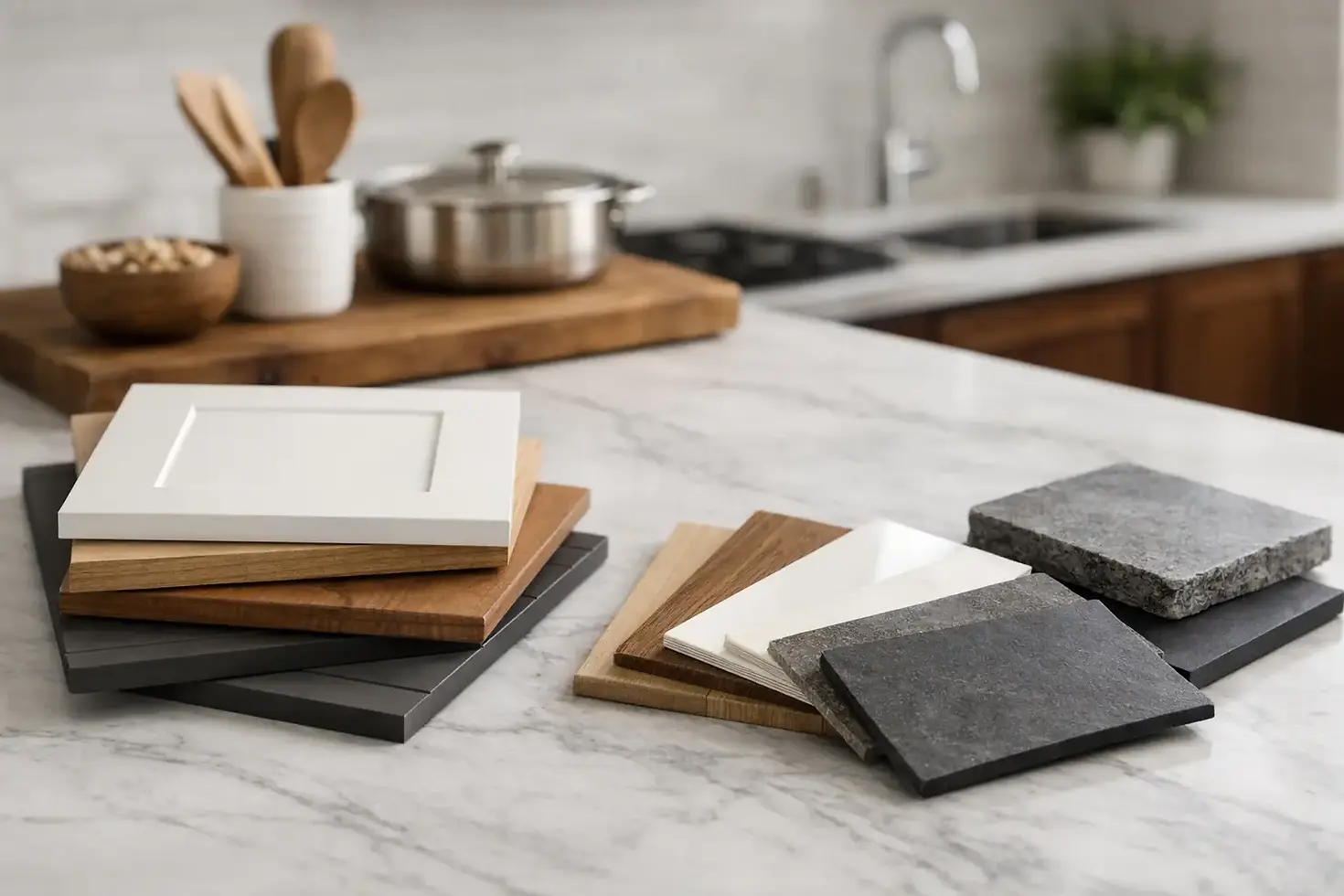
Best Cabinet Materials for Kitchens
- Willy Penner

- May 6
- 6 min read
If you are planning a kitchen renovation, cabinet material is one of the decisions that will shape how the space looks, feels, and holds up over time. The best cabinet materials for kitchens are not always the most expensive ones - they are the materials that match your layout, your finish goals, and how hard your kitchen works every day.
That is where many homeowners get stuck. A showroom sample can look great in isolation, but kitchens are real working spaces. Heat, moisture, fingerprints, heavy dishes, kids, pets, and daily traffic all test cabinet construction in ways a sample door never will.
What makes the best cabinet materials for kitchens?
The right answer usually comes down to four things: durability, finish quality, stability, and budget. If you want cabinetry that feels substantial and wears well, the box construction matters just as much as the door style. If you want a painted finish, the material under that paint matters even more.
There is no single perfect material for every project. A custom kitchen often performs best when different materials are used in different places. For example, plywood may make the most sense for cabinet boxes, while MDF may be the better choice for painted doors. Solid wood can be the standout feature on stain-grade fronts or decorative details, but it is not automatically the right answer for every cabinet part.
Plywood cabinets
Plywood is one of the most respected cabinet materials for kitchen box construction, and for good reason. It is made from thin layers of wood veneer bonded together in alternating grain directions, which gives it strength and dimensional stability.
In practical terms, that means plywood cabinet boxes tend to hold up well under weight and resist warping better than many lower-cost alternatives. Shelves, drawer supports, and side panels built from quality plywood can provide the sturdy feel homeowners expect in a long-term kitchen investment.
Plywood also handles fasteners well. Hinges, drawer hardware, and screws generally get a secure hold, which matters in kitchens where cabinet doors and drawers are opened constantly.
The trade-off is cost. Plywood is typically more expensive than particleboard or MDF when used for cabinet interiors and structural components. Quality also varies. Not all plywood is equal, so thickness, core quality, and veneer grade all matter.
For many custom projects, plywood is a strong choice for cabinet boxes because it balances durability, performance, and long-term value.
Solid wood cabinets
Solid wood is often the material homeowners ask about first. It has natural beauty, real grain variation, and the kind of depth that many people want in a high-end kitchen. For stained finishes especially, solid wood remains one of the best-looking options available.
Hardwoods such as maple, white oak, walnut, and cherry are common choices for cabinet doors, drawer fronts, and face frames. Each species brings a different character. Maple is smooth and versatile. White oak offers visible grain and a clean, architectural look. Walnut adds warmth and richness. Cherry deepens in color over time.
Solid wood does come with a few realities. It expands and contracts with humidity, which is normal but important to understand. In a kitchen, that movement can affect how painted finishes perform and how wide panels behave over time. That is one reason solid wood is often better suited to stain-grade applications or select components rather than every part of the cabinet.
It is also typically one of the more expensive options. If your goal is a painted kitchen, solid wood is not always the most practical material for the door fronts. If your goal is warmth, texture, and a furniture-quality finish, it can be an excellent choice.
MDF cabinet doors
MDF, or medium-density fiberboard, is a manufactured wood product made from fine wood fibers and resin. It is dense, smooth, and consistent, which makes it especially useful for painted cabinet doors and panels.
For homeowners choosing a painted kitchen, MDF is often one of the smartest materials to consider. Because it has no natural grain, it creates a very smooth painted surface. It is also less likely than solid wood to show seasonal movement through the finish, which can help reduce visible cracking at joints over time.
That said, MDF is not ideal everywhere. It is heavy, and it does not hold screws quite the same way plywood or solid wood does in high-stress structural applications. It also does not respond well to prolonged moisture exposure if edges or finishes are compromised.
Used in the right place, MDF performs very well. Many custom cabinet makers rely on it for painted doors, end panels, and decorative components where a crisp, refined finish is the priority.
Particleboard cabinets
Particleboard is generally the budget-driven option. It is made from wood particles and adhesive pressed into sheets, and it is commonly used in lower-cost cabinet lines.
Its biggest advantage is price. For some projects, that matters. But when homeowners are investing in a long-term kitchen renovation, particleboard usually comes with compromises in strength, moisture resistance, and overall lifespan.
If water reaches unfinished edges or penetrates the surface, particleboard can swell and break down more quickly than plywood. It is also less dependable for heavy-use kitchens where drawers, pull-outs, and hardware take daily wear.
That does not mean every cabinet with particleboard is automatically poor quality. Some manufactured systems perform adequately, especially in dry, controlled environments. But for a kitchen expected to feel solid and last, it is rarely the top recommendation.
Thermofoil and laminate surfaces
When homeowners talk about cabinet materials, they are sometimes also referring to the finish surface rather than the core material. Thermofoil and laminate are two common examples.
Thermofoil uses a vinyl layer applied over an MDF core, often for a sleek painted look at a lower price point. It can be easy to clean and visually uniform, but heat can be a concern. Areas near ovens, ranges, or heat-producing appliances may show wear sooner.
Laminate is a synthetic surface bonded to a substrate. It is durable, consistent, and available in many colors and patterns. In the right design, laminate can be a practical, modern choice. It is often more about function and finish consistency than the natural character of wood.
These materials can work well in specific styles and budgets, but they usually do not deliver the same custom feel as painted or stained wood-based cabinetry built for the space.
How to choose the best cabinet materials for kitchens
The smartest way to choose is to match the material to the purpose.
If you want painted cabinetry, MDF doors paired with plywood cabinet boxes are often a strong combination. You get the smooth painted finish homeowners love, with a sturdy structural base behind it.
If you want a stained or natural wood kitchen, solid wood doors and visible components can bring the warmth and depth that make the room feel tailored. Plywood interiors can still provide reliable performance behind the scenes.
If budget is the main driver, there may be places to simplify without undercutting the whole project. The key is knowing where lower-cost materials are acceptable and where they create problems later.
This is also where custom cabinetry has an advantage. Instead of forcing one material into every part of the kitchen, a custom approach allows each element to be built with the right balance of durability, appearance, and value.
Material choice is only part of cabinet quality
Even the best material can fall short if the cabinet is poorly built. Joinery, finish application, hardware quality, installation precision, and layout planning all affect how the final kitchen performs.
A well-designed cabinet should not just look good on day one. It should open smoothly, align cleanly, support weight properly, and fit the room without filler-heavy compromises. That is why material selection works best as part of a larger conversation about how you use your kitchen and what you want from the finished space.
At Stone Mill Cabinetry, that is the value of a consultation-led process. Homeowners do not need to guess which product label sounds best. They need guidance on which materials make sense for their design, their finish preferences, and the way their family lives.
If you are comparing options, start by looking at real project results, not just samples. Then talk through your priorities with a cabinet professional who can explain the trade-offs clearly. The best kitchen cabinets are not built from the most talked-about material - they are built from the right materials, in the right places, for the way your home actually works.


Comments