

How Custom Kitchen Cabinets Are Installed
- Willy Penner

- May 18
- 6 min read
A kitchen can look polished in drawings and still fail in the field if the installation is rushed. That is why homeowners often ask how custom kitchen cabinets are installed - not out of curiosity alone, but because the install stage is where fit, function, and finish either come together or fall apart.
With custom cabinetry, installation is not a simple drop-in exercise. The cabinets are built for the room, but the room still has to be verified, prepared, and managed carefully. Floors may be slightly out of level. Walls may bow. Appliance locations need to be exact. A well-run installation accounts for all of that before the first cabinet is permanently fastened.
How custom kitchen cabinets are installed, step by step
The process usually starts before installation day. Final measurements are confirmed after demolition, framing changes, flooring decisions, and rough-ins are far enough along to trust the space. This matters because custom cabinets are built to real dimensions, not broad assumptions. If the room changes late, even a beautiful cabinet package can become a problem.
Once the site is ready, installers establish reference lines on the walls. These lines show the finished height of base cabinets, the position of wall cabinets, and the relationship between runs. This is one of the most important parts of the job. Cabinets do not get installed by eye. They are set from control lines so the entire kitchen stays level, aligned, and consistent.
Base cabinets are often installed first, especially when the layout depends on a precise countertop height and appliance fit. In some kitchens, wall cabinets go in first to keep the floor area open and reduce the risk of damage. The right sequence depends on the room, the cabinet design, and access. There is no single rule that fits every project.
Site prep makes the install go smoothly
A proper installation starts with a clean, stable workspace. Finished flooring may already be in place, or the cabinetry may be set before the final floor goes down, depending on the material and project plan. Either approach can work, but the cabinet heights and appliance clearances need to be planned accordingly.
Walls must be drywalled, reasonably flat, and ready for layout. Plumbing and electrical rough-ins should be complete and in the right locations. If a water line sits where a sink base back panel needs support, or an outlet lands inside a finished end panel, installers are forced to adjust in ways that waste time and compromise the result.
This is also the point where appliance specifications are checked again. A custom kitchen is built around exact clearances. Refrigerators, ranges, vent hoods, and dishwashers all influence opening sizes, panel details, and filler widths. A half inch in the wrong place can become visible fast.
Level and plumb come before fastening
Few homes are perfectly square. Installers expect that. They use shims, laser levels, and straightedges to correct for uneven floors and walls before cabinets are secured. The goal is not to follow the room as it is. The goal is to create a level, plumb cabinet installation that gives countertops, doors, and reveals a clean finished look.
In practical terms, that means finding the high point of the floor first. Base cabinets are set from that point so no cabinet ends up too low once the run is complete. If one side of the room drops, the cabinets are shimmed to maintain a level top line. Those small corrections disappear once toe kicks and trim are installed, but they are critical to the final fit.
Installing the base cabinets
Base cabinets carry much of the functional load in a kitchen. They support countertops, house sinks, anchor islands, and define most appliance openings. Installers typically begin in a corner or another fixed reference point and work outward, checking each cabinet for level, plumb, and alignment before joining it to the next one.
Adjacent cabinet faces are clamped flush so the fronts line up properly. Then the cabinets are fastened together and secured to the wall through structural points designed for that purpose. This protects the cabinet box and helps the whole run act as a unified system instead of a collection of separate pieces.
Openings for plumbing or electrical are cut carefully and only where needed. In custom work, those cuts should look intentional and clean, not hacked out in a hurry. If a sink base, pull-out trash unit, or integrated panel is part of the design, each piece has to land exactly where the plan intended.
Islands add another layer. They may be anchored to the floor, built up with decorative legs or panels, or positioned around electrical feeds. Because islands are visible from multiple sides, installation quality shows more clearly. Panel alignment, overhang support, and symmetry all matter.
Installing wall cabinets and tall units
Wall cabinets need secure backing and accurate placement. They are lifted into position along the layout lines, shimmed as needed, and fastened through strong points into wall framing. Because they are more exposed at eye level, even small alignment issues stand out. A slight dip across the bottom line of wall cabinets is easy to spot once under-cabinet lighting or tile goes in.
Tall pantry cabinets and oven units are even less forgiving. They have to stand plumb, meet surrounding cabinetry cleanly, and accommodate built-in appliances with very little tolerance for error. If the floor slopes or the wall leans, the installer has to correct that while keeping the reveals consistent.
This is where experience matters. Custom cabinetry is supposed to look fitted, not forced into place. Filler strips, scribe pieces, and finished panels are used to absorb irregularities at walls and corners so the installation looks intentional from end to end.
Fillers, scribes, and trim are not afterthoughts
Homeowners sometimes focus on door style and finish, but installation details are what make cabinetry look truly custom. Filler strips create the right spacing where cabinets meet walls, appliances, or adjacent runs. Scribe pieces are trimmed to follow uneven wall surfaces so there are no awkward gaps. Decorative moldings and finished panels complete exposed ends and transitions.
These pieces are measured and fitted on site because real rooms rarely match plans perfectly. That is normal. What matters is how well those conditions are handled. Clean scribes and balanced fillers are often the difference between a premium result and a kitchen that feels almost right.
Doors, drawers, and final adjustments
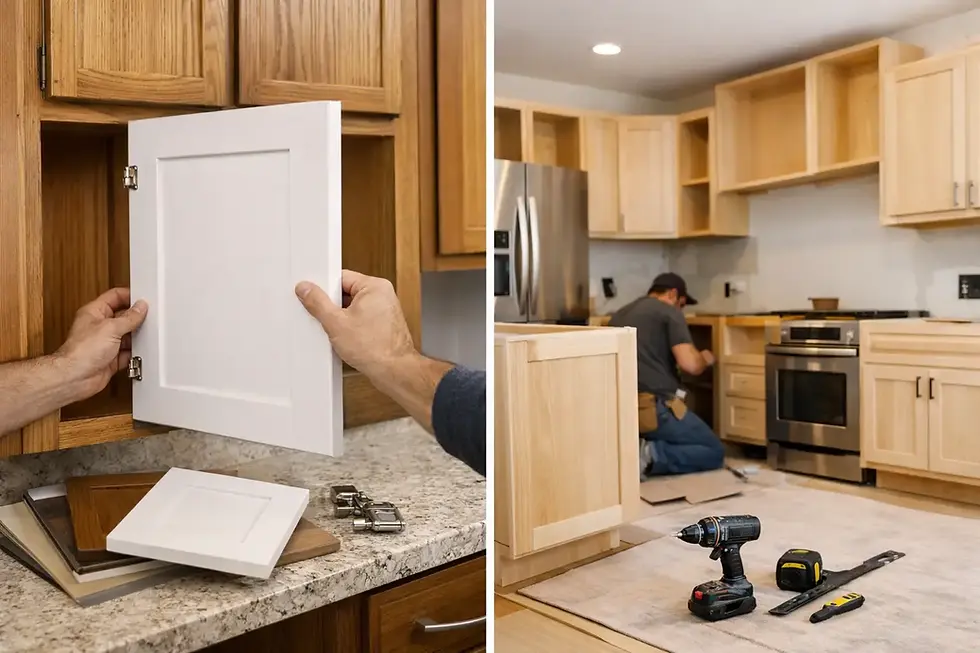
Once the boxes are in place, doors and drawer fronts are adjusted so the spacing is even and the operation feels smooth. Soft-close hardware, pull-out systems, and specialty storage features are checked and fine-tuned. This stage can look minor from the outside, but it has a major effect on how the kitchen feels every day.
A custom installation should not leave you fighting sticky drawers or doors that drift out of alignment after the first week. Good installers make final adjustments with long-term use in mind. They check reveals, hinge tension, drawer travel, and hardware placement so the cabinetry not only looks right but works the way it should.
If countertops are templated after cabinet installation, the installer also makes sure the cabinet tops are ready for that next phase. Any issue with level or support will show up quickly once stone or solid surface tops are measured.
What can affect the timeline
Most homeowners want to know how long installation will take. The honest answer is that it depends on kitchen size, complexity, site readiness, and coordination with other trades. A straightforward kitchen may move quickly. A larger project with paneled appliances, stacked moldings, a detailed island, or multiple tall units will take longer.
Delays usually come from conditions outside the cabinetry itself. Walls may need correction. Flooring might not be finished. Appliance specs may change late. Electrical or plumbing rough-ins may land in the wrong place. Custom work handles these conditions better than stock cabinetry, but no install is immune to poor prep.
That is why a consultation-driven process matters. Clear planning upfront reduces field surprises and protects the finished result.
What homeowners should look for during installation
The right installation should feel organized, not chaotic. You should see layout lines, careful handling, measured adjustments, and steady progress. Cabinet fronts should align cleanly. Gaps should be intentional and consistent. Exposed ends should look finished, and appliance openings should match the approved plan.
If you are comparing providers, ask to see completed projects, not just cabinet samples. Installation quality is easier to judge in real kitchens than in isolated showroom pieces. Testimonials help, but visual proof matters too. This is especially true for homeowners investing in a forever kitchen, where long-term fit is just as important as first impression.
At Stone Mill Cabinetry, that install stage is treated as part of the craft, not the final errand on the schedule. The goal is a kitchen that fits your home the way it was meant to be there from the start.
If you are planning a renovation and want cabinetry built for your space instead of adapted to it, view the gallery, book a consultation, and start with a layout that deserves a precise finish.


Comments