
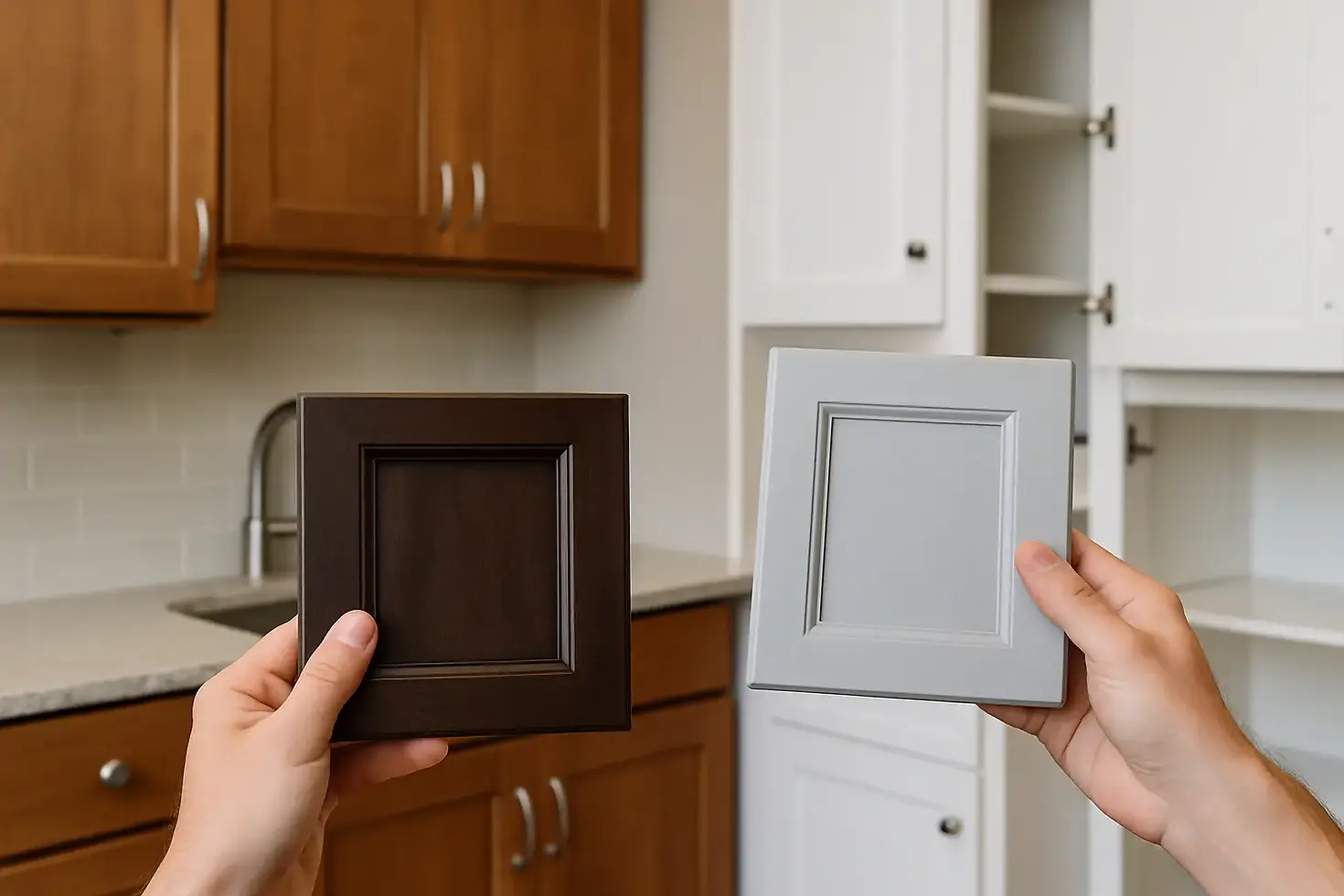
Custom Cabinets vs Semi Custom: What Fits Best?

That corner by the fridge that always feels tight. The drawer that can’t open because a handle bumps the range. The pantry that somehow holds less than it should.
Most homeowners don’t start a kitchen or storage project thinking about cabinet “categories.” They start with daily friction. And that’s why the decision between custom cabinets vs semi custom matters - it’s not just about price. It’s about whether your cabinetry is built around your room, or your room is forced to behave around your cabinetry.
Custom cabinets vs semi custom: the simplest definition
Semi custom cabinets are built from a manufacturer’s catalog of sizes, door styles, and finish options, with some flexibility. You can typically adjust a few dimensions, choose from upgrade tiers, and add accessories. The system is designed to cover most kitchens without starting from scratch.
Custom cabinets are made-to-order for your exact space. Heights, depths, widths, interior layouts, and details are built around your plan, not pulled from a fixed list. That doesn’t automatically mean “fancier.” It means the work is tailored - especially where real homes rarely cooperate: out-of-square walls, tight walkways, odd soffits, and must-have storage goals.
If you’re deciding between the two, the most useful question is this: do you need cabinetry that adapts to your space, or can your space adapt to the cabinetry?
Where semi custom tends to work well
Semi custom can be a smart choice when the room is straightforward and the design doesn’t need unusual sizes. If your kitchen footprint is typical, the ceiling height is standard, and you’re comfortable with a few fillers or spacers, semi custom can deliver a clean finished look.
It can also work well when the goal is primarily a surface refresh: new door style, new color, updated hardware, and improved function through common add-ons like pull-out trash or rollout trays. For some homeowners, that’s the right level of change.
The trade-off is that “close enough” is often baked into the layout. You might gain a nice new look, but leave storage potential on the table because the boxes weren’t built to maximize every inch.
Where custom cabinets earn their keep
Custom cabinets make the biggest difference in the places you feel every day - clearance, workflow, and storage efficiency. When cabinets are designed for how you cook and how your home runs, small improvements stack up fast.
Custom is especially valuable when:
Your walls are out of square, ceilings vary, or the floor slopes (common in real homes, especially older ones).
You want full-height cabinetry that finishes cleanly at the ceiling instead of stopping short with a gap or tall filler.
You need specific storage solutions: a pantry wall sized for appliances, drawer stacks tuned to your cookware, or a hard-working mudroom drop zone.
You’re integrating built-ins across multiple spaces and want a consistent look from kitchen to vanity to closet.
There’s also a visual difference you can feel, even if you can’t name it at first. When proportions are planned for your room - not a manufacturer’s standard - the whole space looks more intentional.
Fit and layout: the decision most people underestimate
Most “cabinet regret” isn’t about door style. It’s about layout compromises.
Semi custom layouts often rely on filler strips to bridge gaps between standard cabinet sizes and real-world measurements. Some filler is normal in any install, but too much filler can reduce storage and create awkward dead zones - especially near corners, appliances, and door casings.
Custom cabinetry can reduce those compromises by building to the exact run length and by shaping the design around obstacles. That can mean deeper uppers where appropriate, a slightly wider base cabinet to avoid a skinny pull-out you’ll never love, or shifting proportions so the room reads balanced.
If you’re already investing in new counters, new appliances, or a larger remodel, the layout is where you want your money working for you.
Storage and function: it’s not just “more,” it’s smarter
Semi custom brands often offer popular storage accessories, and many of them are genuinely helpful. The limitation is that the interior is still constrained by the cabinet box sizes available.
Custom cabinets allow you to plan storage from the inside out. Instead of asking, “Which accessory fits this box?” you’re asking, “What do we store here, and how should it work?” That leads to solutions like drawers sized for plates so you stop stacking, dedicated vertical storage for trays, or a pantry that accounts for the actual appliances you own.
If you cook often, have a busy household, or you’re trying to make a smaller kitchen live larger, custom layout planning is usually the quickest path to a kitchen that feels calmer.
Materials and construction: what varies, and what to ask
Quality isn’t exclusive to either category. You can find solid construction in semi custom lines, and you can also find “custom” that’s mostly marketing. What matters is asking the right questions.
Two homeowners can both say “we’re getting semi custom,” and one ends up with a durable, well-finished product while the other gets a cabinet that feels light and wears quickly.
When you’re comparing options, focus on the parts you interact with and the parts you can’t easily change later: box construction, joinery, drawer build, and the finish system. Ask what’s standard and what’s an upgrade, and get clarity on what you’re actually paying for.
If you want cabinetry that holds up for the long haul, don’t be shy about requesting specifics. A trustworthy cabinet partner will answer directly.
Design flexibility: door styles are only part of it
Semi custom offers a curated set of door styles and finishes, which can be a benefit if you want to choose quickly. But that same curation can be limiting if you’re trying to match existing millwork, create a truly one-of-one look, or carry details into adjacent spaces.
Custom opens up more than “more choices.” It allows alignment and proportion control that makes a kitchen feel built-in to the home. Think consistent reveal lines, intentional hood surrounds, furniture-style details, and trim that resolves cleanly into the architecture.
If you’re investing in a premium countertop or statement lighting, cabinetry that’s designed to match the level of the rest of the room tends to make the whole renovation feel cohesive.
Timeline and decision-making: what to expect
Semi custom can be faster in some cases because the boxes are produced from a standard system. But “faster” isn’t guaranteed. Lead times vary widely by brand, finish selection, and demand.
Custom work involves design, build, and installation scheduling, and it typically benefits from early planning. The upside is that the process can be more controlled when you’re working with a team that manages details end-to-end.
Either way, the best way to protect your timeline is to lock in decisions early: appliance specifications, sink type, hood plan, and any must-have storage features. Cabinetry touches everything, so changes late in the game can ripple into counters, electrical, and flooring.
Cost: the honest way to think about budget
Semi custom is often priced below custom, but the gap can narrow depending on upgrades and how many modifications are needed to make the layout work.
Custom is an investment, and it should be treated like one. You’re paying for tailored design, precise fit, and a result that uses your space efficiently. The value shows up in day-to-day function and in the finished look buyers notice if you ever sell.
A practical way to decide is to rank what matters most.
If budget is the top priority and the room is simple, semi custom can make sense.
If fit, storage performance, and long-term satisfaction are the priorities, custom tends to justify itself - especially in kitchens and primary suites, where you live with the details every day.
How to choose between custom and semi custom for your home
If you’re still stuck, here are four questions that usually make the answer clear.
First: are you dealing with a tricky room? Older homes, uneven walls, tight clearances, and low windows are strong signals for custom.
Second: do you want full-height, built-in results? If you don’t want visible gaps, large fillers, or “almost to the ceiling,” custom is often the cleanest path.
Third: is storage a real pain point? If the current kitchen wastes space or forces bad habits, custom planning can fix the root cause instead of adding a few organizers.
Fourth: how long do you plan to stay? If this is a long-term home, paying for cabinetry that fits better and wears well is usually money well spent.
If you’d rather talk through your space with someone who builds made-to-order cabinetry every day, Stone Mill Cabinetry offers a consultation-driven process that starts with your goals and ends with a finished install you can trust.
A quick reality check: mixing both can be the right answer
Some projects don’t require an all-or-nothing approach. A common strategy is to use custom where it matters most - a feature wall, a tricky corner, a built-in pantry, or a mudroom drop zone - and keep other areas more standard.
The best plan is the one that respects your budget without forcing you into compromises that will annoy you for years. If you’re already opening walls, upgrading appliances, or changing the kitchen footprint, it’s worth pausing to make sure the cabinetry choice supports the bigger investment.
A helpful closing thought: choose the option that lets you stop thinking about your cabinets once they’re installed - because when the fit is right and the storage works, the kitchen finally feels easy.


Comments